
Proper 13, Year A, Track 2
Isaiah 55:1-5
Psalm 145: 8-9, 15-22
Romans 9:1-5
Matthew 14:13-21
It has been about two months since our season of Ordinary Time started us on the path of Jesus’ earthly ministry as recorded by the Gospel of Matthew. By now some of you may have noticed that there has been a distinct lectionary focus on Jesus’ teachings, especially in parables. The Gospel according to Matthew does have a distinct focus on the sayings and teachings of Jesus. Matthew’s emphasis is on the proclamation of Jesus as the Jewish Messiah and the fulfillment of God’s covenant with Israel, so naturally we have a great deal of explanation to connect Jesus to the Hebrew scripture in these ways. We have been so immersed in Jesus’ words the past several weeks that perhaps we haven’t realized that today’s Gospel reading is the first time in this cycle of Ordinary Time that we are encountering a specific miracle performed by Jesus.
That is not to say that Jesus has only been talking this whole time. Matthew has recorded roughly a dozen distinct miracles Jesus has performed up to this point in the story. Many of these are clustered in Chapters 8-9, and almost all of them are healing miracles. This helps explain why over 5,000 people—note the 5,000 counted does not include women and children, so the crowd was likely much larger—would stream out of the surrounding towns to go find Jesus. They were there not simply to hear him speak, but to seek his help.
The Jesus they—and we—encounter here is in a tough situation. We read that he withdrew by himself to a boat on the water. Just prior to today’s reading, Jesus had learned about Herod’s execution of John the Baptist. This undoubtedly was a source of deep grief for Jesus. John was his kin by blood, the prophet who prepared the way for his own ministry, and the man who performed his baptism. Jesus might also have withdrawn because Herod had become aware of Jesus and his activities, and attributed the miracles that had taken place up to this point to Jesus being John the Baptist raised from the dead.
But what Jesus sees awaiting him on the banks moves him: a sea of faces who had come to be healed. He comes ashore and spends the whole rest of the day curing the sick. It’s worth noting that massive resource disparity in ancient Judea meant that then, just as now, the poorest could often not afford even basic staples. This led to malnutrition and illness. It’s quite likely that many of the ailments Jesus cured among the gathered crowd were caused or exacerbated by insufficient nutrition.
By evening, the disciples, perhaps concerned with the well-being of the people in the crowd, encourage Jesus to wrap things up and send them on their way before it got dark. But Jesus responds, “They need not go away; you give them something to eat.” Notice Jesus does not say, “They need not go away; I will feed them.” He says, “you give them something to eat.”
I want you to imagine if on any given Sunday, instead of 5-10 people coming to coffee hour after service, there were 50. Imagine the scramble to find something to defrost from the freezer, the dash to the grocery store for something that is filling and quick to prepare. Or imagine volunteering at the Sunshine Food Pantry on a food distribution day. Some of you have seen the long lines that already queue up early Thursday mornings at the Pantry. Now imagine that on one of those Thursday mornings, every third person in Galt—about 8-10,000 people in total—was waiting outside, hungry and needing to be fed. But we don’t need to ponder hypotheticals, because food insecurity in Sacramento County is higher than our state and national averages, with an estimated 1 in 4 residents experiencing or in danger of experiencing hunger, per the Sacramento Food Bank. In raw numbers, that is roughly 427,000 people.
But even seeking to feed 50 can feel as daunting as 427,000 when the resources we see in front of us simply aren’t enough. The disciples identify the scant food they have mustered: “We have nothing here but five loaves and two fish.” Were that divided among only Jesus and the Twelve, it still wouldn’t have been much of a meal. In John’s account of the Feeding of the 5,000, it is Andrew who pipes up to identify the food they have—five barley loaves and two fish—but he also asks the question we all would in such a situation: “But what are they among so many people?”
And the answer is, of course, that it is not enough. The disciples collect all the food they have, and it is not nearly enough on its own to make a meaningful difference. You may have noticed that I paused during our lesson after the disciples identified the limits of what they could accomplish. I did so to give us space to recognize the moment of disappointment that slips in before the happy resolution. Failure to accomplish our own ambitions is a let-down, but for most people, the feeling that we have failed others is worse. And for people of faith, the feeling that we have failed at what God has called us to is often worst of all. The disciples would fail again after this, and would fail in far more grievous and consequential ways later. And Jesus would continue to do what he does in today’s story: he takes the gifts and best efforts they offer and multiplies them into something miraculous. Mother Teresa is often quoted as saying: “God has not called me to be successful. He has called me to be faithful.”
That truth is an exceptional gift, because it frees us from the fruitless and disappointing obsession with winning or being the best. It frees us from despairing that we cannot cure all the ills of this world, and safeguards us against the inevitable pride that would grow in us if we could. And it necessitates that we work in harmony and community with one another to build the kingdom of God on earth.
But faithfulness is work, and sometimes the call to faithful service comes on our worst days, as it does for Jesus in this story. We have all found ourselves overtaxed and running on empty. Yet the invitation Isaiah spoke to a people who had lost everything applies to us all: come to the waters; you that have no money, come, buy and eat, without money and without price. We are fed before we are sent, with food that we have not and could not earn.
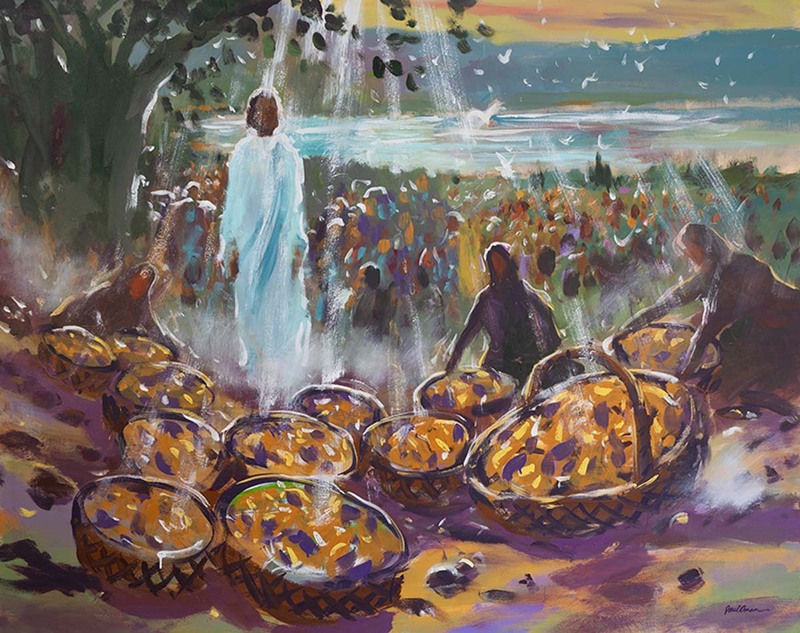
When Jesus took the bread that was gathered by the disciples, he looked to heaven, blessed and broke it, and then gave it to the disciples, who gave it to the crowd. Whenever that same act is repeated at the Eucharist, we receive a small bite of bread that gives us nourishment we can find nowhere else. Then, as we turn to face the weary world again, Jesus says to us, “you give them something to eat.”
Matthew tells us that when the crowd had eaten and was filled, the disciples gathered up twelve baskets of what was left over. So bring what you have, insufficient as it is, and give it to God. And when you have seen what God can do with it, you will look inward and find that remarkably, you too may have more left over than what you started with. Amen.