
Easter 5, Year A
Acts 7:55-60
Psalm 31:1-5, 15-16
1 Peter 2:2-10
John 14:1-14
When I was a boy of about seven or eight, I lived on the outskirts of Galt, just a short distance from Dry Creek. The house where I lived was on an acre of land, and behind it lay empty fields stretching all the way down to the creek. The only boundary we had delineating our yard from the farther field was the length of the grass. As a boy I knew that once I had wandered into the tall grass, I was beyond our yard. One of my favorite past-times during late spring and early summer, when the earth was still moist enough to dig, was to dig a shallow pit just beyond the mow-line and use the heavy Valley clay to build things. I was inspired by images I had seen in books of mudbrick structures like those built by the Pueblo peoples. By the summer I’d have built an entire replica village, filled with the stories and people conjured in my imagination. Of course, wind and rain would erode the village each winter, and I kept trying out new things to build it up stronger and make it last. Eventually I begin scouring the back field for rocks. I’d gather up handfuls, take them back to my little village, and figure how I could precisely fit them to my designs.
It was this pastime that put the idea into my head from an early age that I would grow up to become an architect. I was fully set on this career for much of my childhood until, when I got older, I discovered how much math was involved. Turns out I was probably not designing or building my backyard civilizations up to code, either.
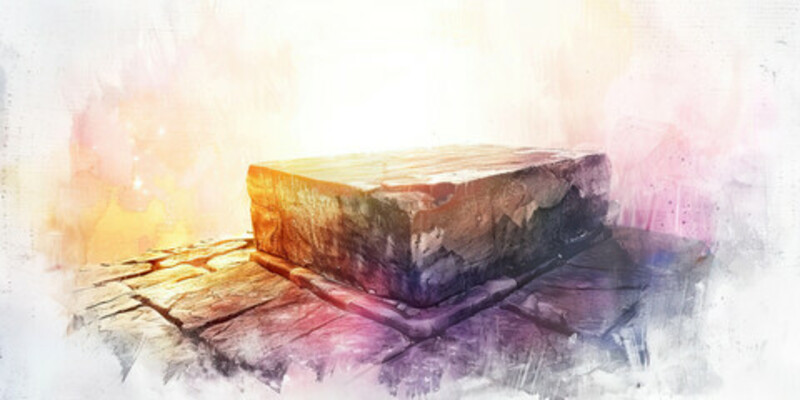
Our reading today from 1 Peter emphasizes the image of us as God’s raw materials, in the same way that Christ identifies Peter as the rock upon which he will build the Church. We are also identified as “living stone, rejected by mortals,” just as Christ himself is described as the stone the builders rejected, which becomes the chief cornerstone. Christ is rejected as the chief cornerstone because the architects interpreting God’s blueprint could not conceive of a design where he would fit—or indeed, where his placement would not bring down much of what they had already built. Likewise, as living stone, the friction of our own rejection in this world can be traced to the blueprint in which we are used. To fit seamlessly into every pattern, design, or structure is not our destiny.
It is also not our destiny to only be the stone waiting to be moved and placed. Paul reminds us in 1 Corinthians 3 that we are God’s coworkers, as that as his coworkers we are building something upon the foundation of Jesus Christ. What we build with, and how we build with it, will determine how long it lasts. I think many of us struggle with that question at some point in our lives of what it is we are building, and to what end. Sometimes we are bombarded with such a vast array of choices and plans that we are overwhelmed with indecision. Other times, we see ourselves trapped in what appears to be the wrong design, with no clear way out, or worse—we feel lost in a plan that has only been half-built, and since abandoned.
But in God’s kingdom, we are a builder and a stone. These two callings can feel like they pull against each other. The stones did not travel to my little village on their own; they were passive, stationary things that I had to seek out. But when I picked them up, they became part of a new creation. When we are firmly planted, we can begin to see what is meant to take shape around us, and we can partake in the work of building it.
Around that same age as I was building mud and rock replicas of the great cities of the ancient world, I was also cultivating a new hobby. Every week I would drag a tall stool from the kitchen into the living room and use it as a pulpit for my Bible. And every week, my Grandma Maxine was my kind, patient, encouraging audience of one as I extemporaneously riffed on whichever passage of scripture had caught my interest. From my birth to her passing, she was the unimpeachable moral compass of my life. She was not perfect, and would be the first to say that, but she embodied those things from the Book of Micah that the Lord requires—do justice, love kindness, and walk humbly with your God. She had been a coworker of God long enough to see in my play preaching a new stone being placed.
Even in today’s distressing reading from Acts, which recounts the martyrdom of Stephen, we can see something being built. Based on the Biblical account Luke describes to us, Stephen is one of the most gifted and persuasive messengers of the Gospel at the time. The entirety of Acts 7 up to this point is a sweeping retelling of the covenantal history between God and Israel, and through the story Stephen makes two major points: that the people of Israel have a long history of ignoring those God sends to instruct them in his ways, and that the dwelling place of God is not a physical place but a spiritual space in the hearts of all who receive him. It is with this speech that Stephen also foreshadows his own imminent death at the hands of those who cannot bear to hear what the Spirit is saying through him.
As the crowd is about to stone Stephen, they lay their coats at the feet of a young man named Saul. There’s a few reasons why they may have done this, but a likely one is that this young man was in some way overseeing or supervising the execution. Stephen’s last words are, “Lord, do not hold this sin against them.” Even at this moment of agony and death, Stephen sees a new thing being built. Just a few chapters later in Acts, this young man Saul is blinded on the way to Damascus, an encounter that will change his entire life even down to his name, now Paul, redeemed and forgiven by God. Stephen’s example of faithful courage is the blueprint Paul follows to his own eventual martyrdom.
God’s designs for us are rarely such extremes as this, of course. I have now been preaching in this congregation for about 10 years, and since last year I’ve been helping teach new lay leaders and deacons in four California dioceses about preaching as a part of the West Coast Collaborative. In many ways I feel the work of creation alive in me in a way I have not since I was a boy in the backyard.
After my grandmother passed away, her headstone was engraved with a portion of John 14:2: “In my Father’s house are many dwelling places.” In cheeky paraphrase of the King James Translation of that verse she also had an editorial comment engraved as well: “I’m not here, I’m in my mansion.” I can picture with Johannine literalism the image of my grandmother lounging in a sort of Beverly Hills suspended in the clouds with all her fellow saints who’ve earned a good rest. But as we are continually reminded in Stephen’s speech in Acts and in 1 Peter, we are the mansions. We are the dwelling places where God abides. And if, as Jesus says, he “will take you to myself, so that where I am, there you may be also,” then the coworkers of God who have helped build us also abide in us through that spiritual work.
Each day, we build something and are used to build something around us. We have a choice in what we build, and what materials we bring to it. Do we bring patience, kindness, and gentle encouragement when we see God’s designs begin to work in another? When we come together in this church, built to God’s glory, do we likewise build up the people beside us as sacred places for God to dwell? Do we look inward with enough compassion and grace that we can recognize the holy dwelling places inside us? Do we believe Jesus when he says, “the one who believes in me will also do the works that I do and, in fact, will do greater works than these?”
“How can I possibly see the way that God is working in me and through me?” we ask. And Jesus provides us the answer: “I am the Way, and the Truth, and the Life.” Amen.